
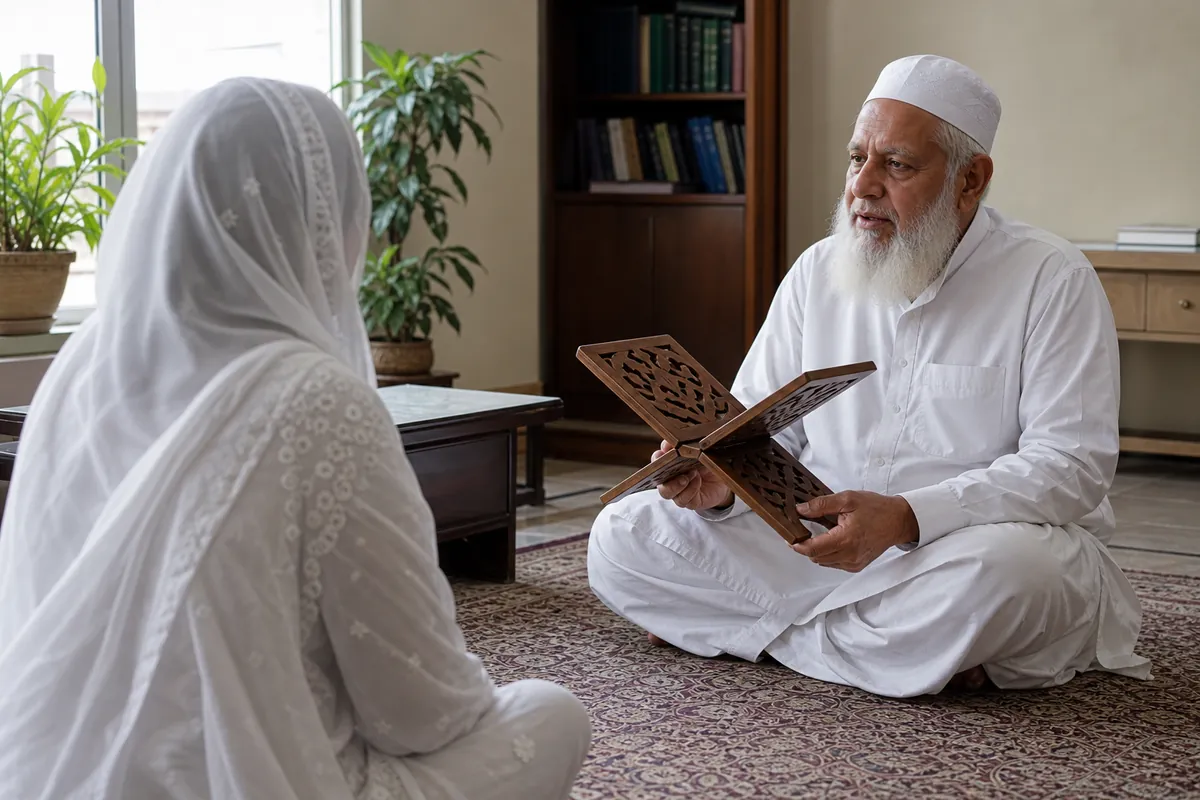
Executive Summary: Khula in Islam and Pakistani Law
What Khula in Islam Means
Khula in Islam is a separation sought by the wife, in which she gives back what she received in consideration of the marriage. It differs from talaq, which the husband pronounces, and from dissolution on fault grounds, where the wife proves cruelty, desertion or non-maintenance under the Dissolution of Muslim Marriages Act 1939.
Who Needs This Guidance
This page is written for wives considering separation, for families who want to understand the religious position before acting, and for overseas Pakistani women whose husbands live in Pakistan. It also helps husbands who have received a suit and want to know how khula in Islam is treated by the court.
Fee Basis
Our professional fee is quoted after the documents are reviewed, because the work on a case of khula in Islam depends on whether dower, dowry, maintenance or custody are also claimed. See our consultation fees page for how first meetings are charged. We do not publish fixed packages for contested family matters.
Usual Time Frame
Where reconciliation fails at the pre-trial stage, a decree can follow within a few hearings, but the overall time depends on service of summons, the court’s cause list and any connected claims. Contested dower or custody issues take longer than a simple claim of khula in Islam. No timeline can be guaranteed by any advocate.
How to Start
Send us your Nikah Nama, CNIC copies and a short note of the facts on WhatsApp at +92 333 1127834. An advocate reviews them, explains whether khula in Islam or a fault-based dissolution suits your case better, and then sets out the documents and steps required.
Advocate-Led Since 1985
Family Lawyers Pakistan is part of Qanoon Group, a network of advocates practising since 1985. About seventeen advocates work with us, including two Advocates Supreme Court. Matters of khula in Islam and other family cases in Karachi are supervised by Syed Akhtar Rizvi, Advocate Supreme Court, with our Head of the Family Practice, Sobia Mohsin.
The Quranic Basis of Khula in Islam: Surah Al-Baqarah 2:229
The foundation of khula in Islam is verse 2:229 of the Quran. After setting out the limits on revocable talaq, the verse says that if the spouses fear they cannot keep within the limits set by Allah, there is no blame on either of them for what the wife gives to free herself.
Classical jurists read this verse as the root of khula in Islam, giving the wife a recognised route out of a marriage she cannot sustain, even where the husband has committed no legal fault. The consideration she returns compensates the husband, and the separation follows. The verse also warns against transgressing Allah’s limits, which guides how fairly khula in Islam should be handled.
The Hadith of the Wife of Thabit ibn Qais
The leading precedent for khula in Islam is the hadith, recorded in Sahih al-Bukhari, of the wife of Thabit ibn Qais. She came to the Prophet (peace be upon him) and said she found no fault in her husband’s character or religion, but feared ingratitude within Islam if she remained in the marriage.
The Prophet asked whether she would return the garden Thabit had given her as dower. She agreed, and Thabit was told to accept the garden and separate from her. Jurists draw three lessons about khula in Islam: the wife need not prove fault, her aversion is a sufficient reason, and the return is generally limited to what she received.
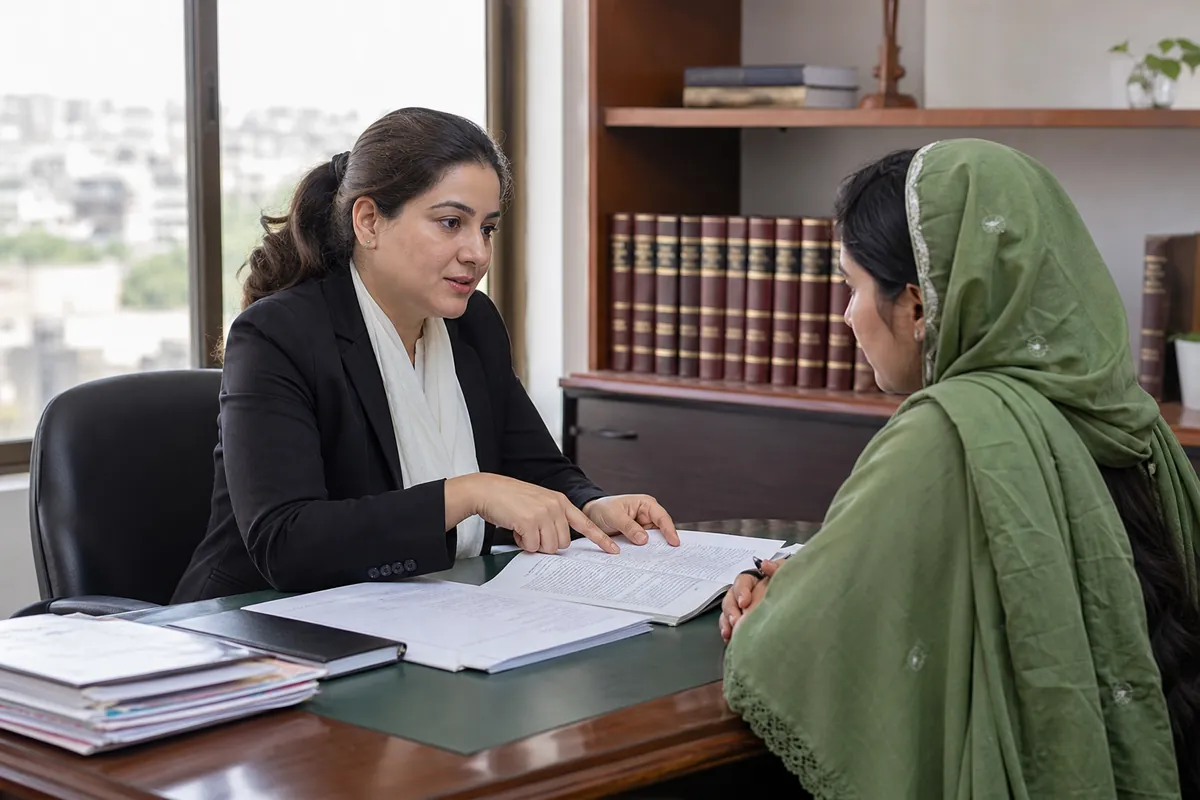
Returning the Dower and Other Benefits
Under khula in Islam the consideration is ordinarily the dower or benefits received from the husband in connection with the marriage. Many scholars discourage the husband from demanding more than he gave. Pakistani courts follow a similar approach and look at what was actually paid, not at sums written in the Nikah Nama but never handed over.
- Prompt dower already received by the wife is the usual starting point for any return under khula in Islam.
- Deferred dower that was never paid is not something khula in Islam requires the wife to return.
- Gifts from her own family and her dowry articles remain her property under the Dowry and Bridal Gifts (Restriction) Act 1976.
- Benefits the husband alleges were given must be proved by him through evidence before the court.
How Pakistani Courts Apply Khula in Islam: Khurshid Bibi
The Supreme Court settled the modern position in Khurshid Bibi v. Muhammad Amin, PLD 1967 SC 97. The Court held that a wife is entitled to khula in Islam where the judge is satisfied that the spouses cannot live together within the limits of Allah, and that the husband’s consent is not a precondition for the decree.
This judgment is why khula in Islam, as applied in Pakistan, works as a judicial remedy rather than a private bargain the husband can block. The court examines the wife’s stated aversion, attempts reconciliation, and then decides what consideration, if any, she must restore. Later case law has built on this foundation consistently.
Khula in Islam Under the Family Courts Act 1964: Decree at Pre-Trial
The Family Courts Act 1964 gives Family Courts exclusive jurisdiction over dissolution of marriage, including khula, and requires the court to attempt reconciliation at the pre-trial stage. In a suit based on khula in Islam, if reconciliation fails, the Act directs the court to pass a decree for dissolution without waiting for a full trial.
A decree of khula in Islam also deals with the dower received by the wife, which the court may direct her to restore. Provincial amendments have adjusted the details of this restoration, so the current text applicable in Sindh, Punjab or Islamabad should be checked for each case. Our advocates confirm the position before the suit is drafted.
What Happens at the Pre-Trial Hearing
Both parties are called before the judge, who asks whether the marriage can be saved. The wife’s reasons for seeking khula in Islam are heard in plain terms. If she maintains that she cannot continue, the court records the failure of reconciliation, passes the decree and, where required, directs the return of dower received.
Khula in Islam Compared With Pakistani Court Practice
The table below sets the classical principle beside the way a Pakistani Family Court applies it today. It is a summary of khula in Islam for orientation only; the facts of each marriage, and the provincial amendments in force, decide the outcome of an individual case.
| Issue | Classical principle | Pakistani court practice |
|---|---|---|
| Who initiates | The wife seeks separation. | The wife files a suit in the Family Court. |
| Husband’s consent | Debated among the classical schools. | Not required after Khurshid Bibi, PLD 1967 SC 97. |
| Grounds | Aversion and fear of exceeding Allah’s limits. | Court satisfied the spouses cannot live within those limits. |
| Consideration | Return of dower or benefits received. | Court decides restoration of dower actually received. |
| Finality | Separation is irrevocable. | Decree sent to the Union Council Chairman for the statutory process. |
Iddat After Khula and the Union Council Process
After a decree, the Family Court sends a copy to the Chairman of the Union Council. Under the Muslim Family Laws Ordinance 1961, the procedure that applies to talaq, including the ninety-day period, governs dissolution otherwise than by talaq. A dissolution by khula in Islam becomes effective at the end of that statutory process.
Jurists differ on the length of iddat after khula in Islam: some follow a hadith indicating one menstrual cycle, while the Hanafi school treats it like talaq iddat. In practice, a woman in Pakistan should complete both the Union Council process and her iddat before remarriage, and take advice where the two appear to differ.
Dower, Dowry and Maintenance After Khula
Seeking khula in Islam does not mean giving up everything. Unpaid deferred dower is ordinarily lost, but dowry articles stay with the wife and can be claimed in the same suit. Our guide to dowry articles recovery in Pakistan explains that claim in detail.
Past maintenance the husband failed to pay may also be claimed, and the court can award it with a decree of khula in Islam. For the dower position specifically, see our page on haq mehr in Pakistan. Each of these claims needs its own evidence, which our advocates help you collect before filing.
Children After Khula in Islam: Custody and Maintenance
A khula decree ends the marriage, not the parents’ duties. Custody is decided separately under the Guardians and Wards Act 1890, where the welfare of the minor is the paramount consideration. Choosing khula in Islam does not by itself cost a mother custody of young children, though remarriage and other facts may be weighed.
The father remains responsible for maintaining his children whatever the reason for separation. Claims for custody, visitation and child maintenance can be filed with a suit for khula in Islam or later. Our child custody lawyers in Pakistan handle these questions alongside the dissolution so that nothing is left unresolved.
Common Misunderstandings About Khula
Families often arrive with ideas about khula in Islam that are not accurate under Pakistani law. Clearing these up early saves time, avoids unnecessary conflict and lets the case for khula in Islam be presented calmly and accurately.
- The husband cannot stop a khula decree simply by refusing to agree.
- A wife does not have to prove cruelty or fault to obtain khula in Islam.
- Khula does not automatically decide custody of the children.
- Dowry articles are not part of the consideration returned to the husband.
- A decree of khula in Islam is not effective for remarriage until the statutory process is complete.
Taking the Next Step on Khula in Islam With Our Advocates
Once you understand the religious and legal basis of khula in Islam, the practical steps are drafting the plaint, filing in the correct Family Court and attending the pre-trial hearing. Our separate guide to khula procedure in Pakistan covers those filing steps, documents and court stages in order.
If you would like an advocate to look at your Nikah Nama and explain your options on khula in Islam, send it on WhatsApp at +92 333 1127834. Meetings in Karachi and Lahore are by prior appointment, and our Islamabad team handles matters in Islamabad and Rawalpindi.

Khula in Islam: Frequently Asked Questions
Is khula permitted in Islam?
Yes. Khula in Islam rests on Quran 2:229 and on the hadith of the wife of Thabit ibn Qais, in which the Prophet allowed her to return the garden she had received and separate from her husband. Classical jurists across the schools recognise it as the wife’s route out of a marriage.
Does my husband have to agree to khula?
No. Since Khurshid Bibi v. Muhammad Amin, PLD 1967 SC 97, a Pakistani Family Court may grant khula in Islam where it is satisfied that the spouses cannot live within the limits of Allah. The husband is heard, but his refusal does not prevent the decree.
Do I need to prove cruelty to get khula?
No. Khula in Islam does not require proof of fault. A wife who can prove cruelty, desertion or non-maintenance may instead seek dissolution under the Dissolution of Muslim Marriages Act 1939, which can protect her dower. An advocate can advise which route suits your facts.
What must I return to my husband?
Under khula in Islam you ordinarily return the dower or benefits you actually received in consideration of the marriage. Unpaid deferred dower is not returned because it was never received. The court decides the amount on the evidence, and provincial amendments affect the details, so take advice on your own case.
Can I keep my dowry after khula?
Yes. Dowry articles and gifts from your own family are your property and are not part of the consideration for khula in Islam. You can claim their return in the same Family Court suit, supported by lists, receipts, photographs or witnesses showing what was given.
When is a khula decree passed?
Under the Family Courts Act 1964 the court attempts reconciliation at the pre-trial stage. In a suit for khula in Islam, if reconciliation fails, the court passes the decree for dissolution at that stage. The total time still depends on service of summons and the court’s schedule.
How long is iddat after khula?
Scholars differ on iddat after khula in Islam: one view relies on a hadith indicating one menstrual cycle, while the Hanafi school applies the ordinary iddat. In Pakistan you should also complete the ninety-day Union Council process before remarrying, and seek advice if unsure.
Will I lose custody of my children after khula?
Not automatically. Custody is decided under the Guardians and Wards Act 1890 on the welfare of the child, and choosing khula in Islam is not decisive. Remarriage, the child’s age and other circumstances may be considered. The father must still maintain the children.
Can I file for khula from abroad?
Yes, a claim of khula in Islam can usually proceed through a special power of attorney executed abroad and attested as the court requires, with an advocate appearing in Pakistan. The court may still require your personal statement at some stage, which can sometimes be arranged by video link, depending on the judge.
Is a khula decree from Pakistan valid in Islam?
A decree granted by a Pakistani Family Court after hearing both sides and attempting reconciliation is the recognised form of khula in Islam within Pakistan’s legal system. Questions about recognition abroad depend on the law of the country where you live and need separate advice.
Related Legal Services
These pages cover connected questions that often arise alongside khula in islam.
- Khula Lawyers in Pakistan for Khula Proceedings, Dower and Connected Family Claims
- Dissolution of Muslim Marriage in Pakistan
- Haq Mehr in Pakistan
- Child Custody Lawyers in Pakistan for Custody, Visitation and Interim Care Arrangements
- Family Lawyers in Karachi for Divorce, Khula, Custody and Maintenance
Legal Framework Behind Khula in Islam
The explanation above draws on the official framework listed here. Provincial amendments and the facts of each matter must still be checked before acting.
Publication and Legal Review
Reviewed by: Syed Akhtar Rizvi, Advocate Supreme Court.
Published by: Family Lawyers Pakistan, Qanoon Group.
Last updated: .
General guidance. The applicable law, local amendments and case record must be checked for your matter.